






Over the years we've written thousands of resumes to help professionals land jobs and we've written extensively about resume mistakes to avoid.
But we wanted to take it a step further and quantitatively analyze a sample of real resumes submitted to a real job in order to determine which resume mistakes job seekers are making most frequently.
So we analyzed 100 random resumes that were submitted for a job…and not just any job, but for a Career Consultant / Resume Writer role with ResumeSpice. Given that the role requires the ability to write powerful resumes, with exceptional attention to detail (as outlined in the job description), one would expect errors to be less frequent. At least that was our thinking.
After randomly selecting 100 resumes, we reviewed them for content, spelling, grammar, and format – as most recruiters would.
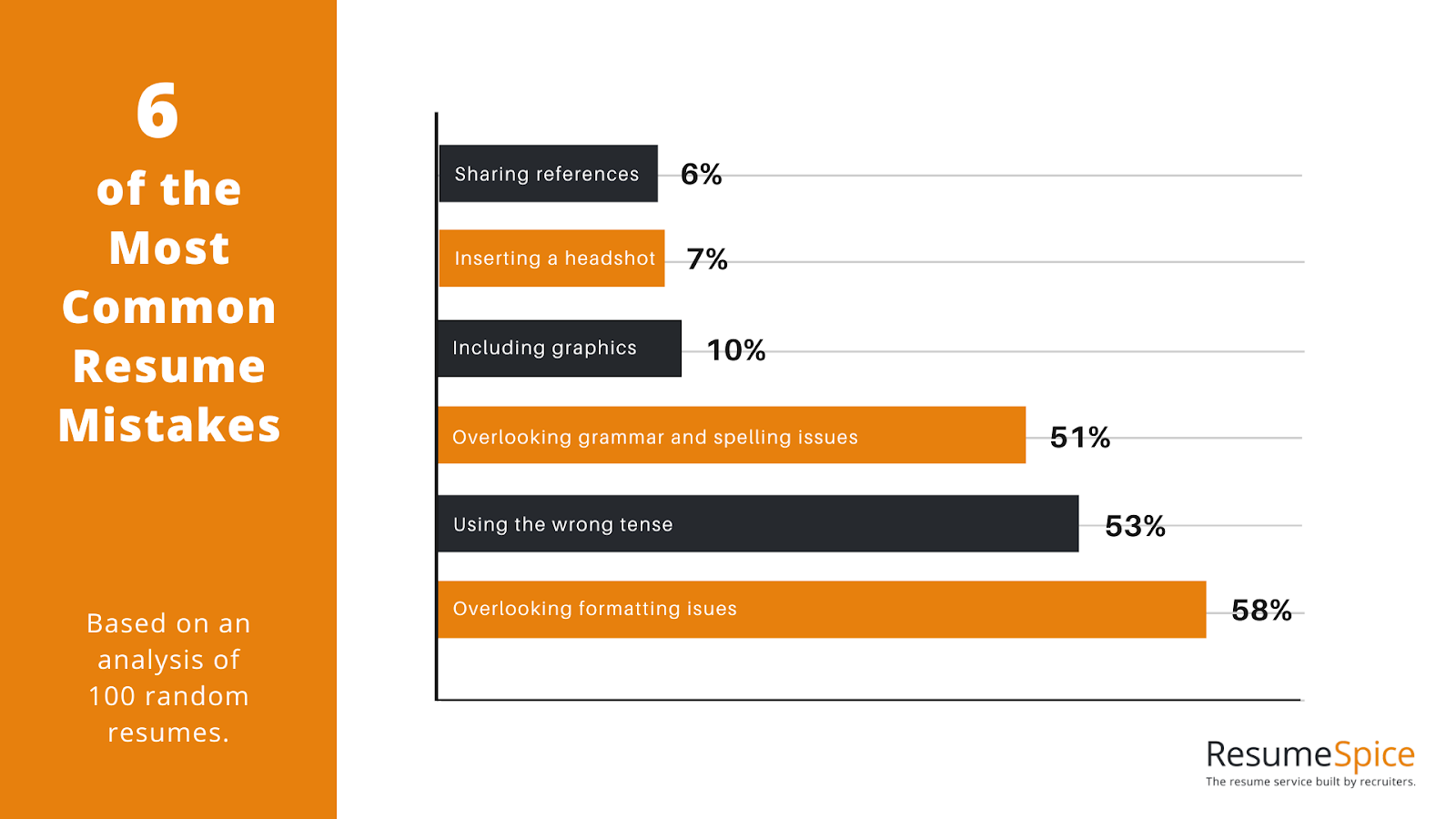
Below were the most 6 common resume mistakes we found, starting from least common to the most frequent.
Introduction to Resume Analysis
A well-crafted resume is the foundation of a successful job search, serving as your first introduction to hiring managers and recruiters. Resume analysis is the process of carefully reviewing and refining your resume to ensure it effectively highlights your skills, qualifications, and experience. By understanding and addressing the most common resume mistakes, job seekers can significantly improve their chances of making a positive impression and securing an interview. In a competitive job market, it’s essential to write a resume that not only avoids common errors but also showcases your unique strengths and career achievements. In this article, we’ll break down the key elements of a standout resume and share practical tips to help you present your qualifications in the best possible light – so you can move confidently through the hiring process.
Understanding Resume Objectives
Traditionally, many job seekers included a resume objective at the top of their resume to outline their career goals. However, hiring managers and recruiters now view resume objectives as outdated and often irrelevant to the job at hand. Instead, it’s far more effective to replace the resume objective with a professional summary. This brief section should highlight your most relevant qualifications, skills, and accomplishments, tailored specifically to the job description and job posting you’re targeting. By focusing on what you can offer the employer – rather than what you hope to gain – you’ll make a stronger case for your candidacy. Incorporating keywords from the job description also helps your resume pass through applicant tracking systems, increasing your chances of being noticed by hiring managers. Remember, your professional summary is prime real estate on your resume, so use it to quickly demonstrate why you’re the right fit for the position.
Effective Work Experience
When it comes to writing resumes, how you present your work experience can make all the difference. Rather than simply listing job duties from past positions, job seekers should focus on highlighting their accomplishments and the impact they made in each role. Use bullet points to organize your work history and make it easy for hiring managers to quickly identify your key contributions. Start each bullet with strong action verbs like “managed,” “developed,” or “implemented” to convey a sense of initiative and achievement. Whenever possible, quantify your results – such as “increased sales by 25% within six months” or “reduced processing time by 30%.” This approach not only demonstrates your value to potential employers but also helps your resume stand out in a crowded field. By focusing on measurable accomplishments, you show hiring managers exactly what you can bring to their business.
Customizing Your Resume
One of the most common resume mistakes job seekers make is submitting the same resume for every job application. Hiring managers can easily spot a generic resume that hasn’t been tailored to the specific position, which can hurt your chances of moving forward in the hiring process. To avoid this pitfall, take the time to customize your resume for each job posting. Carefully review the job description and highlight the skills and qualifications that are most relevant to the role. Incorporate keywords and phrases from the job posting into your resume, and use similar language to describe your experience and achievements. This not only shows that you’ve done your homework but also helps your resume get past applicant tracking systems. Above all, be honest and accurate when representing your qualifications -focus on what makes you a strong fit for the position, and avoid exaggerating your experience. Customizing your resume for each application demonstrates your commitment and attention to detail, qualities that hiring managers value in job candidates.
6. Including a List of References – 6% of resumes
Strong references from current/former colleagues and managers are important assets in your career search, but it’s no longer necessary to include them on your resume.
Why? Two reasons:
- They’re implied – employers know you have references and will ask for them at the appropriate stage in the hiring process.
- They take up valuable space. Every line of your resume is valuable. Use that space to include key information about your skills, experience, and education. Including unnecessary personal details, such as a personal photo or an unprofessional email address, can also detract from your resume's professionalism.
And if the above doesn’t convince you, including references ages your resume. It’s no longer the norm to do so, so be careful about inviting (conscious or subconscious) age bias into the mix. Using an unprofessional email address is another common mistake that can harm your chances with employers.
While neither a list of references nor the statement “references available upon request” should be included on your resume, we do suggest creating a separate reference list – with contact information – so that you’re ready to send them when an employer requests them.
5. Including a Headshot – 7% of resumes
A professional photo on your resume might seem like a good idea, but many recruiters view headshots on resumes as unprofessional and/or they intentionally steer clear of them to avoid any perception of discrimination based on gender, race, age, or other factors.
Discrimination concerns aside, including an image on your resume can confuse applicant tracking systems (ATS), as they are not able to properly decipher photos. Not only can graphics be distracting, but your resume has a greater chance of passing through an ATS if it’s simple and text-based. Maintaining adequate white space in your resume layout is essential for readability and ensures your information is easy to scan for both recruiters and applicant tracking systems.
Instead of including a resume headshot, pay close attention to your social media profile pictures and content. Recruiters will visit LinkedIn, Facebook, Instagram, Twitter, and other social media platforms if they want to learn more about you.
For your LinkedIn profile, ensure you have a professional headshot without distracting backgrounds or colors. Your face should take up at least 60% of the frame. Check out this article for more tips on how to improve your LinkedIn profile picture.
4. Including Colors / Graphics – 10% of resumes
Unless you’re applying for a graphic design position or a similar creative role, there’s no reason to include fancy graphics, fonts, or color on your resume.
But 10% of resume applicants in our analysis added some form of graphics. These graphics included:
- Name logo as the header
- Circle icons with illustrations
- Computer, email, and house elements to illustrate contact info
- Brightly colored boxes
Not only can graphics be distracting, but your resume has a greater chance of passing through an ATS if it’s simple and text-based.
Example resume with unnecessary graphics
Graphics might be fun and creative, but let the content of your resume do the heavy lifting. That’s where recruiters and hiring managers focus.
Stick with tried and true resume formats and fonts that are easy and let your accomplishments speak for themselves. Using a clean, straightforward format is helpful for ensuring your resume is easily read.
3. Grammar and Spelling Issues – 51% of resumes
This is where the frequency of errors picked up significantly, with approximately half of all resumes we reviewed including grammar and/or spelling issues. Grammar mistakes can undermine your professionalism and reduce your chances of advancing in the hiring process.
It’s easy to understand why. When you’ve been staring at a document for hours, using “manger” instead of “manager” or confusing they’re / there / their happens.
Here are just a few of the grammar/spelling mistakes we found in our analysis:
- “Thru” instead of “thorough”
- “english” instead of “English”
- “As an member” instead of “as a member”
- “Thoughts leaders” instead of “thought leaders”
- “The departments chances” instead of “the department’s chances”
While understandable, typos can be the difference between getting an interview – or not. 79% of recruiters cite spelling and/or grammatical errors as resume deal breakers.
To eliminate typos, follow these steps:
- Enable grammar and spell check within Word or whichever program you’re using to build your resume.
- Download free grammar tools such as Grammarly to automatically search and flag resume errors.
- Read your resume out loud several times. Our brains will often correct errors when we read silently.
- Print out a copy of your resume and thoroughly check each section, highlighting any issues.
- Lastly, have a second party (with impeccable grammar!) review your resume, looking for any missed typos.
2. Using the Wrong Tense – 53% of resumes
While using the wrong tense is technically a “grammar” issue, we broke it out as its own section because it was that common. In fact, on its own, incorrect tense usage was the second most common resume mistake we found, with 53% of applicants using the wrong tense at least once within their resume.
**The most common issue?**Describing past duties in the present tense. While describing present duties in the past tense did occur, it was not as common as the former.
For example, if you included the bullet “Create weekly social media posts for clients” or “Develop competitive analysis reports” in your resume, but it described a task you undertook for a marketing job you had three years ago, using the present tense would be incorrect.
You would need to update the sentence to read “Created weekly social media posts…” or “Developed competitive analysis reports…” to demonstrate that it happened in the past.
The exception: If a sentence refers to a project that you already completed. For example, maybe you organized a one-time event for your current position. In that case, using the past tense would be appropriate, i.e. “Organized the 2020 Sales Rep Challenge.”
For these situations, try to connect a year or date with the past project, if it makes sense to do so, so the reader will know that it’s not a mistake.
1. Formatting Issues – 58% of resumes
The #1 issue we found? Formatting issues. Inconsistent spacing, misaligned bullet points, multiple fonts. These are some of the most common errors comprising the “formatting issues” category.
Formatting issues make it difficult for recruiters and applicant tracking systems to easily review your resume. They also demonstrate a lack of attention to detail, even relegating resumes with otherwise strong content to the proverbial “recycle bin.”
To ensure that your own resume doesn't fall into the poor formatting trap, follow these tips:
- Match spacing and indentations throughout your resume.
- Ensure that work dates are formatted consistently (e.g. 10/20 vs. Oct. 20).
- Be consistent with your use of capital letters.
- Double-check your fonts to avoid using multiple fonts throughout the document.
- If you use periods at the end of bullets (or don't), stay consistent.
- Use bullets and avoid large blocks of text. Readers typically skim if paragraphs are over 1-2 lines.
- Send a PDF resume when possible to lock in formatting.
As recommended under the ‘Overlooking Grammar and Spelling Issues' section above, ask a trusted friend or family member to review your resume to double-check for formatting mistakes.
We also recommend printing your resume, as some mistakes will be more evident on paper. If you're formatting in Word, open your saved copy before sending it to an employer to ensure that the information is structured as intended.
The Importance of Cover Letters
While some job seekers may wonder if cover letters are still necessary, including a well-written cover letter as a separate document can give you a valuable edge in the hiring process. A cover letter allows you to provide additional context for your resume, explain any gaps in your work history, and express your enthusiasm for the position. It’s an opportunity to connect your qualifications directly to the employer’s needs and to highlight what sets you apart from other candidates. When writing your cover letter, use simple language and avoid first person pronouns to keep the focus on the value you can bring to the employer. Clearly explain how your skills and experience align with the job requirements, and demonstrate your genuine interest in the company and the role. By taking the time to craft a thoughtful cover letter, you show hiring managers and recruiters that you’re prepared, professional, and truly interested in the position – qualities that can help you stand out and move closer to landing the job.
Runner-Up Resume Errors
While not as common as the above mistakes, there were a number of additional types of mistakes we found when conducting our analysis:
- Too many / too few pages. How long should a resume be? Candidates with less than five years of experience should typically keep their resume to one page, while those with more experience may use two pages to fully showcase their skills and accomplishments. Here’s a resume length guideline.
- Sharing confidential information (e.g. gender, nationality)
- Failing to provide quantifiable results from past jobs, such as using dollar amounts to highlight financial impact or achievements.
- Failing to mention specific responsibilities and achievements for other jobs, which can make your work history appear incomplete.
- Including unnecessary skills or experience. Listing irrelevant skills or including irrelevant skills can clutter your resume and distract from your core qualifications. Focus on skills that are directly related to the job description.
- Not including relevant courses, internships, or volunteer work, especially if you lack paid experience. Including these can demonstrate valuable knowledge and soft skills.
- Not clearly showing that you are qualified for the position by highlighting relevant knowledge and experience.
- Using a career objectives section, which can be outdated or misused. Instead, integrate your career goals into a professional summary.
- Failing to mention keywords and skills from the job description, which can prevent your resume from passing applicant tracking systems.
We get it. It’s easy to overlook mistakes when you’ve stared at the same document for hours. But creating a polished resume is essential to nailing your first impression with a recruiter or hiring manager.
Stand out from the crowd by creating a resume that is void of errors and filled with relevant information about your professional experience and skills.
You can also take your resume up a notch by working with a professional resume writing service. At ResumeSpice, we work with you to create a compelling resume that grabs the attention of recruiters. We welcome you to view our services – and to reach out if you would like our help.
ResumeSpice is proud to be the #1 rated resume service, and we’d love to work with you!