
How to Tailor Your Resume for Skimming: 5 Simple Changes

As Seen In:






Here’s something that might surprise you: most resumes only get about 7 seconds of attention. That’s it.
And if you’ve spent hours trying getting yours just right, tailoring it for the position, choosing the perfect words, making sure every accomplishment was clear — only to have it disappear into a black hole with no response — it’s incredibly discouraging!
But here’s what we want you to know: more often than not, you probably are qualified for the role. The challenge isn’t your experience — it’s where and how the content is positioned. Hiring managers are moving fast through hundreds of applications, often scanning, not reading to the full extent. If your strongest work isn’t in the spots their eyes land first, it’s likely they will miss it.
The helpful part? That scanning pattern is predictable. Once you know where hiring managers’ eyes go in those 7 seconds, you can put your best work right there. And these adjustments are smaller than you’d think.
At ResumeSpice, we’ve been on the hiring side of things. We’ve also helped hundreds of people make their resumes work with how recruiting teams actually review them. We’re sharing what we’ve learned because we know how exhausting job searching can be, and these tweaks really do make a difference. Let’s take a look!
Key Takeaways:
Recruiters’ eyes follow an F-pattern — top of the page, then down the left side. Knowing this helps you put your best work where it’ll actually be seen.
Your first bullet point under each job is what gets read first. Make it your strongest accomplishment.
If your win isn’t clear in the first few words, it might get skipped. We’ll show you how to fix that.
Tip #1: Understand the F-Pattern (Put Your Best Work Where Eyes Actually Land)
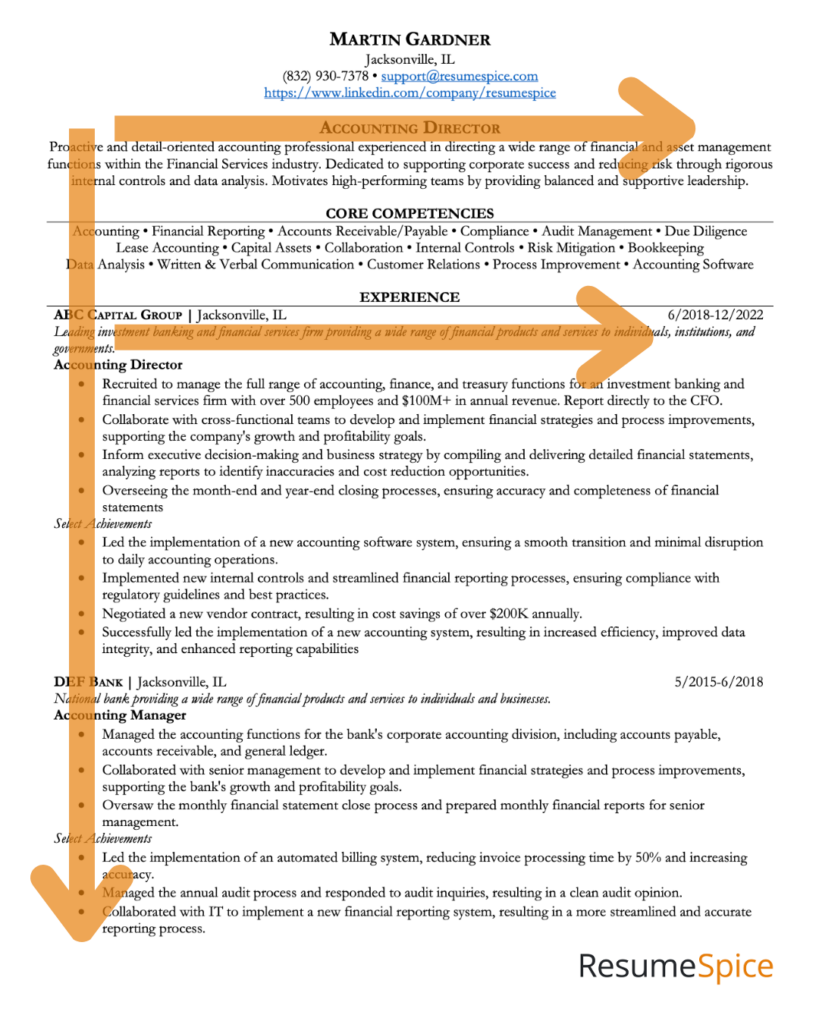
When a busy hiring manager opens up a resume, most of the time their eyes will naturally move in an F-shape. Their eyes sweep across the top third of your page, then drop down and scan vertically along the left margin. Everything else? It’s hit or miss. This isn’t guesswork — it’s based on actual eye-tracking research.
And here’s why this matters for you: your professional summary, core competencies, job titles, and company names sitting along that left edge are getting seen. Your bullet points to the right? Only if the left side has already sparked their interest.
Once you know this, you can use it to your advantage. Put your strongest work in those high-visibility zones, and you’ve just increased your chances of getting a real read instead of a quick skim-and-pass.
✅ What helps you stand out during a skim:
Strong wins in your first bullet points
Keywords in your professional summary and core competencies section
Bold numbers and metrics
Clear section headers aligned left
White space that makes scanning effortless
Readable font size (10-12pt) – check out our blog that answers what font should you use on your resume!
🚫 What can hurt your chances during a skim:
Dense walls of text
Best work buried in the middle
Vague language that needs interpretation
Important details hidden in right-hand columns
Generic opening lines
Tip #2: Use the Right Keywords in Your Summary and Core Competencies Sections
Your professional title, branding statement, and core competencies sections sit in prime F-pattern real estate — the very first thing recruiters see. If this section is full of fluff or buzzwords, their eyes glaze over and they’ve mentally moved on. But if you use this space strategically and align with their job description? You can pass two critical filters at once: the human one and the ATS one.
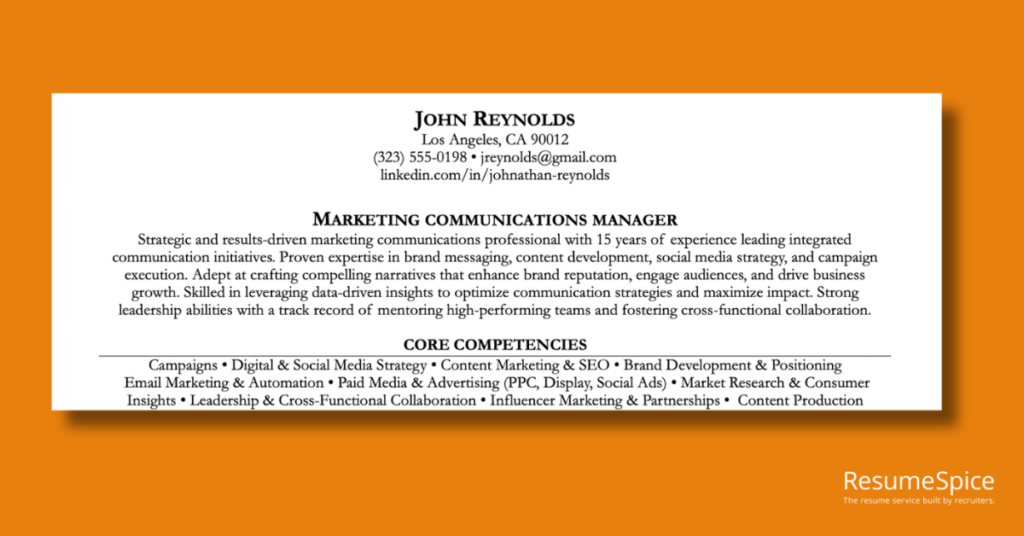
➡️ Your professional title should match the job you’re applying for
Not your current title. Not what you wish you were called. What they’re actually hiring for. If the posting says “Marketing Communications Manager” and your current title is “Marketing Strategist”, you’ve just created doubt, even if the actual job duties completely align. Make it easy for them and use their role title.
➡️ Your branding statement (2-3 sentences) should blend:
What you do and how long you’ve done it
The specific type of company or industry you’ve worked in
Your biggest value add or area of expertise
➡️ Your core competencies section is where keywords matter most
This is the list of 10-15 skills that sits right below your summary. Hiring managers scan this section fast, and ATS systems scan it even faster. Align these keywords with both your actual experience and the specific language in the job description. If the job posting mentions “project management,” “budget forecasting,” or “Salesforce” and those exact phrases show up here, you’ve passed a filter.
➡️ Don’t forget your skills section at the bottom of your resume
Even though this section lives further down your resume and is outside the F-pattern zone, it’s critical for ATS systems. This is where you can list additional key skills and specific software.
🔶 Recruiter Recommendation: Keep a base resume with all your experience and accomplishments (check out our blog, How to Build a Master Resume and Tailor It for Multiple Job Roles). Then for each job you apply to during your job search, spend 10 minutes reviewing the job description. Reorder and adjust your summary, core competencies, and skills sections so the most relevant keywords from the posting appear first. We know many job seekers send the same resume to every employer — it feels faster when you have limited time. But these small tweaks actually make your resume easier to scan and can significantly improve your chances in today’s job market!
Tip #3: Lead With the Win in Your Job Experience Section
Without realizing it, job seekers often will write their job experience bullets chronologically – instead of strategically.
The bullet starts with what you did (like “Led rebranding initiative”) and saves the impressive part for the end (like “increased traffic 85%”). But here’s what’s happening on the other side: busy hiring managers read the first 3-4 words of each bullet, then decide whether to keep going. If those opening words sound like standard responsibilities, they’ve often moved on — even if something really impressive comes later.
The good news? This is incredibly easy to fix. Just flip it. Start with what you achieved, then explain how you did it.
🚫 BEFORE:
Marketing Manager | Tech Company
Led company rebranding initiative that increased website traffic by 85% and generated 200+ qualified leads
✅ AFTER:
Marketing Manager | Tech Company
Increased website traffic by 85% and generated 200+ qualified leads by leading comprehensive rebranding initiative
See the difference? Same accomplishment, same words, just rearranged. But now “Increased website traffic by 85%” hits them right away. You’ve got their attention before they’ve even finished the first line.
🔶 Recruiter Recommendation: Look at the first 4 words of every bullet on your resume. Are they showing your impact? Or describing what you were responsible for? For more inspiration on how to capture a hiring teams attention, check out the 200+ Action Verbs and Power Words to Include in Your Resume
Tip #4: Bold Your Numbers (Make Your Wins Impossible to Miss)
You’ve reorganized to lead with impact. Now let’s make those accomplishments pop off the page.
When someone’s scanning quickly and their eyes hit a bolded 85% or $1.2M, their brain processes it differently than regular text. It stands out. It catches attention. And that split-second of attention can be the difference between them moving on or actually reading your bullet.
Here’s what we suggest: Each role probably has around 2-4 big wins — revenue you generated, costs you saved, efficiency you created, growth you drove. Those are the ones that deserve numbers, and those numbers deserve to be bolded. Everything else (your collaboration, job duties, supporting work) can be just as strong without forcing metrics in. The contrast is actually what makes this work. When most of your bullet points are descriptive but a few have specific metrics, eyes go straight to those numbers.
✅ Let’s improve our Marketing Manager example:
Marketing Manager | Tech Company
Increased website traffic by 85% and generated 200+ qualified leads by leading comprehensive rebranding initiative
Not sure if something deserves a number? Ask yourself: “What actually changed because I did this?” If you can measure it and it’s meaningful, use it and make it bold. If the impact was real but hard to quantify, that’s okay — not everything needs a number.
Tip #5: Your First Bullet Point Gets Read — Make It Count
Even with impact-first writing and bolded numbers, if your biggest accomplishment is sitting in your third bullet, there’s a good chance many recruiters won’t see it. Here’s what actually happens: they glance at your job title and company name, then read your first bullet. If it shows real impact, they keep reading. If it’s just “managed daily operations,” they’ve often moved to the next candidate.
This isn’t fair, and we know it’s frustrating when you’ve worked hard on every line. But it’s the reality of how resumes get reviewed when someone’s looking at hundreds of applications. So here’s what you can control: make that first bullet count.
It doesn’t need to be the first thing you did in the role. It should be the thing you’re most proud of — the project that worked, the result that made a real difference. If someone only reads one bullet, make sure it’s your best one.
Let’s see the full transformation:
🚫 BEFORE (where we started):
Marketing Manager | Tech Company
Managed daily marketing operations and oversaw team of 3 across digital channels
Coordinated with creative team to develop quarterly content calendars and execute email campaigns
Led company rebranding initiative that increased website traffic by 85% and generated 200+ qualified leads
✅ AFTER (applying everything we’ve covered):
Marketing Manager | Tech Company
Increased website traffic by 85% and generated 200+ qualified leads in Q1 by leading comprehensive rebranding initiative
Reduced campaign time-to-launch by 30% by developing integrated content calendar that improved cross-functional coordination
Managed team of 3 junior marketers and oversaw daily operations across content marketing, email campaigns, and paid advertising
Here’s what changed — and why it works:
Every bullet starts with the outcome (Increased, Reduced, Managed)
Numbers are bolded so they catch the eye immediately
Two biggest wins are front and center in bullets 1-2
Daily responsibilities provide important context in bullet 3, but they’re not leading the story
It’s the same person with the same experience. But when someone scans this in 7 seconds, they immediately see that you drive real, measurable results. That’s what makes them stop and actually read.
Looking for professional support? Check out how to find a certified resume writer to help your professional documents stand out from the rest and get noticed by hiring teams.
Summary
You don’t need to redesign your resume from scratch. You just need to understand how hiring managers actually look at it during those crucial 7 seconds, and position your strongest work where their eyes naturally land.
Lead with what you’re proud of. Put your wins first. Use numbers strategically to create visual contrast. Make sure your keywords match what employers are looking for. These aren’t massive overhauls — they’re thoughtful adjustments that help your existing experience get the attention it deserves during your job search.
You’ve worked hard to build real skills and a meaningful career path. Your resume should reflect that — in a way that works with how people actually scan it.
At ResumeSpice, we’ve been on the hiring side, so we know exactly what catches attention and what gets passed over. If you’re tired of sending resumes into the void and want help optimizing yours to get past ATS systems, match the keywords employers are looking for, and land more interviews — we’re here. We write resumes that work with how hiring managers actually review them, from that 7-second skim to the deeper read that follows.
🔶 Ready to move forward?
Resume Writing Services — We’ll build you a resume that gets results
Career Blog — More practical job search advice
Career Coaching — Interview prep, cover letters, and strategy for your next move
Q&A
Q: Do I really need to create a different resume for every job I apply to?
A: You don’t need to create a completely different resume for every job posting, but you should tailor your resume for each application. Keep one base resume with all your experience, then spend 10-15 minutes reviewing the job description and job posting to identify specific keywords and key phrases. Reorder your skills section and Core Competencies so the most relevant skills appear first. Many job seekers send the same resume to every employer because it feels faster, but these small tweaks help you get past Applicant Tracking Systems (ATS) and make your resume easier for hiring managers to scan. When you tailor your resume to match what employers are looking for in the job posting, you significantly improve your chances of getting more interviews.
Q: How do I know if my resume will get past Applicant Tracking Systems?
A: Applicant Tracking Systems (ATS systems) scan your resume for specific keywords that match the job description. To improve your chances, include relevant skills and specific software mentioned in the posting throughout your resume — especially in your professional summary, Core Competencies, and skills section at the bottom. Use the exact keywords and key phrases from the job description rather than synonyms. For example, if they say “project management,” don’t substitute “project coordination.” Make sure your resume has clean formatting, readable font size, and avoids two-column layouts that can confuse ATS filters. When you list skills and technical abilities using the right keywords, you’re more likely to get your resume in front of actual hiring managers.
Q: Should my resume be one page or two pages?
A: If you have less than 10 years of experience, aim for one page. If you have more experience, a solid resume can be two pages. What matters more than length is making sure your strongest qualifications and quantifiable results show up in that top F-pattern zone on page one. Recruiters and hiring managers spend such limited time on each resume — often just 7 seconds — so your best work needs to be visible immediately. Use white space and clean formatting to improve readability rather than cramming everything onto one page with tiny font size. Focus on creating a tailored resume that highlights your most relevant accomplishments for the specific role you’re applying to.
Q: What’s the difference between a professional summary and Core Competencies section?
A: Your professional summary is a 2-3 sentence paragraph at the top of your resume that quickly tells employers who you are, what you do, and your biggest value add. It should speak directly to the job you’re applying for and give hiring managers a clear picture of your experience. Your Core Competencies section sits right below your summary and is a list of 10-15 key skills that match the job description — think of it as your keyword section that helps you get past ATS systems and shows recruiters at a glance that you have what they need. Both sections are in the F-pattern zone where eyes land first, so they’re critical for making a strong first impression and improving your chances in today’s competitive job market.
Q: How can I make my resume stand out when applying to multiple job opportunities in different companies?
A: The key is having one strong base resume, then customizing it for each job opportunity. Review each company’s job description and job posting carefully — look for specific keywords, required skills, job duties, and qualifications they emphasize. Update your professional summary to speak directly to that specific role and company culture. Reorder your bullet points in your work experience section so your most relevant accomplishments for that position appear first. Adjust your skills section and Core Competencies to highlight keywords that match what that employer is looking for. If you’re working with a resume writer or career coach, they can help you create a tailored resume strategy that works across your job search. These adjustments might feel time-consuming when you have limited time, but they make your resume stand out and significantly increase your chances of landing interviews. Remember, you’re not just competing against other job seekers — you’re competing to make hiring managers stop and actually read your resume instead of moving to the next one.